Intumescent Thermal Barrier Coatings Over Spray Foam in Oklahoma City
Exposed spray foam in a shop, pole barn, metal building or crawl space usually needs a protective layer. Where drywall is impractical, a listed intumescent coating such as DC315 can serve as the thermal or ignition barrier, applied at a measured wet thickness around Oklahoma City.
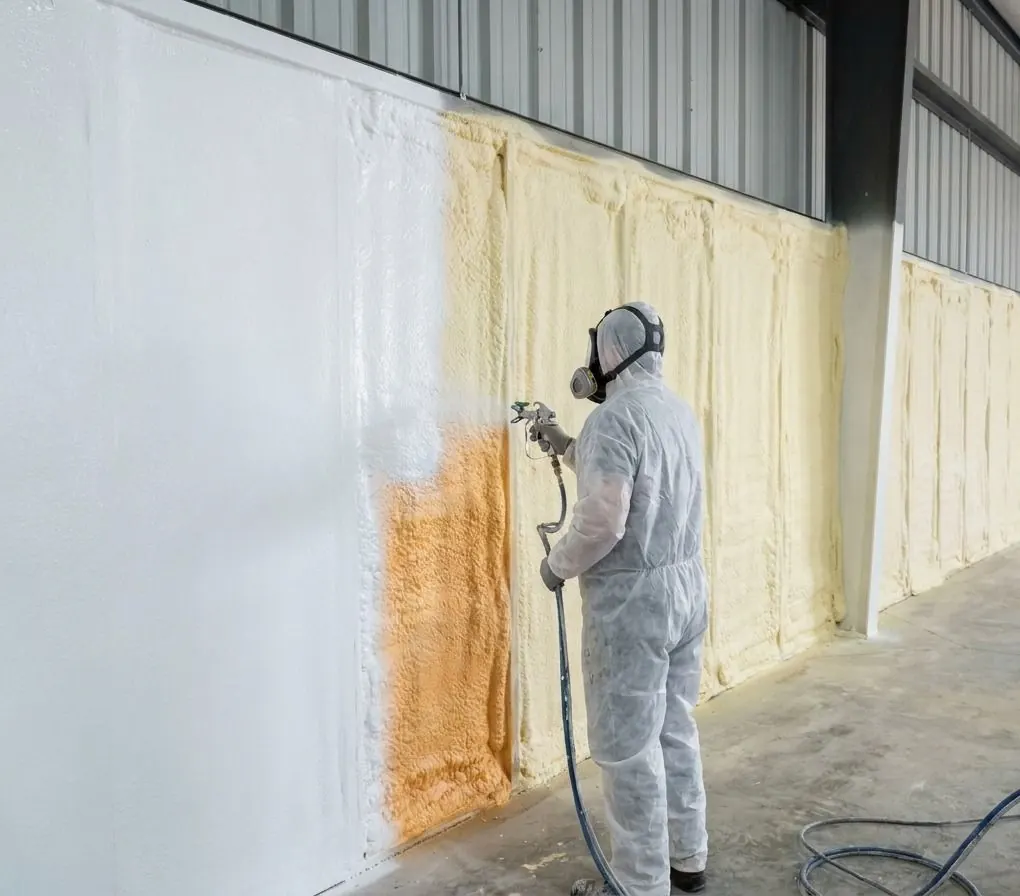
The Problem It Solves
Spray foam is a combustible plastic. Under the IRC and the IBC it has to be separated from occupied space by an approved thermal barrier, usually 1/2-inch gypsum wallboard, and in attics and crawl spaces entered only for service an ignition barrier can apply instead. In a house that is easy, because the drywall is going up anyway. In a steel shop with purlins and girts, a pole barn with posts every few feet, or a crawl space with pipes and ductwork everywhere, hanging drywall over the foam is slow, awkward and sometimes physically impossible.
So the foam gets left bare, and that is a common code problem in Oklahoma outbuildings. A shop where someone welds, grinds or runs a propane heater has the ignition sources right next to an uncovered foam surface. A barndominium-style home with exposed foam in a living area is a failed inspection waiting to happen. An insurer or a buyer's inspector who notices bare foam will ask what protects it, and an answer of nothing is not a good one.
The quick fix people reach for is ordinary paint, or a coating someone found online, rolled on at whatever thickness the bucket happened to cover. That does not work. A coating counts as a thermal or ignition barrier only when it has been tested with that specific foam, at a specific foam thickness and a specific coating thickness, and the result is written into an evaluation report. Without that tie, the coating is just paint on foam, whatever the label says.
How It Works
An intumescent coating such as DC315 is a water-based material applied like paint by spray or roller. When exposed to fire it swells into a thick insulating char that shields the foam underneath, slowing ignition and flame spread and buying time. It does not make the foam noncombustible, and it is not a fire-resistance rating for the building. It is accepted as an alternative thermal or ignition barrier only for the foam products and thicknesses listed together in the foam's or coating's evaluation report, commonly based on testing under ICC-ES AC377, with its Appendix X covering attic and crawl space ignition-barrier use.
Done right, the job starts with the listing, not the bucket. We confirm which foam is on the wall, find the evaluation report that names the coating with that foam, and read off the maximum foam thickness and the required coating thickness. The coating then goes on at a measured wet-film thickness, checked with a wet-mil gauge as it is applied, so the dry film ends up where the listing says. The result is a finished surface with paperwork an inspector can check.
How the Job Runs, Step by Step
Identifying the foam and its report
We confirm the foam product, either from our own records or from the original installer's paperwork, and pull its evaluation report. If the foam cannot be identified, we say so plainly, because the coating cannot be tied to an unknown foam, and drywall or another listed barrier may be the only defensible answer.
Matching coating, thickness and use
From the report we take the approved coating, the maximum foam thickness and the required coating thickness for the use: thermal barrier for occupied space, or ignition barrier for an attic or crawl entered only for service. Foam thicker than the listing allows may need trimming before coating.
Preparing the surface and the space
The foam is cleaned of dust and overspray debris and checked for damage. Equipment, floors and anything not being coated are covered. Air and surface temperature and humidity are brought within the manufacturer's range, which matters in a metal building on a hot August day or a crawl space in winter. A primer is used only if the listing calls for one.
Applying to a measured wet thickness
The coating is sprayed or rolled on in the passes the manufacturer allows. We check wet-film thickness with a wet-mil gauge across every area, paying attention to the edges of purlins, framing, pipes and corners, where it tends to run thin. Thin spots get another pass before the coating dries.
Records for the inspector and owner
You receive the foam product, the coating product, the evaluation report reference, the specified wet thickness and our gauge readings by area. That file is what the city or county inspector, an insurer or a future buyer will want to see. Keep it with the building's other papers.
What Decides the Specification
The evaluation report drives almost everything. It names which coatings are accepted with that foam, the maximum foam thickness the test covered and the coating thickness needed, and the numbers differ between thermal-barrier and ignition-barrier uses. Ignition-barrier coverage in an attic or crawl space entered only for service is commonly lighter than thermal-barrier coverage for an occupied shop. If the foam on the wall is thicker than the report allows, the coating listing does not cover it until the foam is trimmed.
The building then decides whether a coating is the right answer at all. In a barndominium-style home, a living area may call for drywall regardless, and a coating is often reserved for the shop side. In commercial buildings and warehouses under the IBC, the design professional and the evaluation report together set what protects the foam. Surface condition, temperature, humidity and the number of passes needed to reach the wet thickness all shape the schedule.
Oklahoma Code Notes
For houses, the 2024 IRC as adopted in Oklahoma, with state amendments (OAC 748:20-6), requires foam plastic to be separated from the interior by an approved thermal barrier, usually 1/2-inch gypsum, or by an alternative the foam's evaluation report accepts; attics and crawl spaces entered only for service can use an ignition barrier or a tested coating instead. Commercial buildings follow the IBC and the foam's evaluation report. Genuine agricultural buildings are often treated differently, especially in unincorporated areas, so confirm with the city or county and the insurer rather than assuming an exemption. The inspector confirms the listing on site.
General guidance only. The city building department and the product’s own evaluation report decide what applies to your job.
Around Oklahoma City
The shops, pole barns and horse barns on Choctaw acreages are a large share of this work: closed-cell sprayed to the steel to stop summer heat and roof sweating, then coated because nobody wants to drywall a post-frame building. East Norman toward Lake Thunderbird has a similar mix of rural homes and outbuildings. Coatings also go on exposed foam in crawl spaces under older houses, where the ignition-barrier listing is what matters.
Often Done Alongside
2lb Closed-Cell Spray Foam
Dense 2 lb foam for crawl walls, rim joists, concrete and steel buildings.
Commercial Bay & Warehouse Spray Foam
Closed-cell foam sprayed straight onto steel roofs and walls in commercial bays.
Commercial Firestopping
Tested and listed firestop systems for penetrations and joints in rated assemblies.
Where We Do This Work
Thermal Barrier: Questions We Get
Is DC315 the same as fire-resistant paint?
What is the difference between a thermal barrier and an ignition barrier?
How do you prove the coating went on thick enough?
Can an intumescent coating go over old spray foam?
How do you work out what my home actually needs?
Considering Thermal Barrier?
Tell Spray Tech Insulation about the job. We will look at it, tell you whether thermal barrier is the right fix, and price it in writing.