Edmond Insulation for Golf-Course Ranches and Newer Two-Story Builds
Edmond grew outward from a small downtown near the University of Central Oklahoma, and each ring of growth left a different insulation problem behind. Golf-course homes in Kickingbird and Oak Tree tend to need attic work, while the two-story subdivisions to the north and west more often fight a bonus room that never cools. East of town, the questions are about shops and barns.
At a Glance
- Permits issued by
- City of Edmond
- From central OKC
- About 20-30 minutes north
- Main ZIP codes
- 73003, 73012, 73013, 73034, 73025
The Homes and Buildings in Edmond
The older core around downtown Edmond and the blocks near campus is mostly mid-1900s housing: modest single-story homes, some with crawl spaces, many with attics that have been patched and topped up unevenly over the years. Some of those houses are now rentals, where the attic hatch may not have been opened in years and nobody is sure what is up there. A thin, uneven layer, bath fans dumping into the attic and gaps around old flues are common findings in homes of this age. Sealing those and adding depth is straightforward work, provided nothing in the attic needs testing first.
Kickingbird and Oak Tree are the established golf-course neighborhoods, largely built from the 1970s through the 1990s. These are larger ranch and two-story homes, typically brick veneer on slab, with HVAC in the attic and generous ceiling areas. The insulation was reasonable for its day but has had decades to settle, and the attic was often walked through by every trade that ever worked on the house, crushing the fill along the paths to the furnace. Vaulted living rooms and plant shelves add awkward pockets where the insulation is thin or missing altogether.
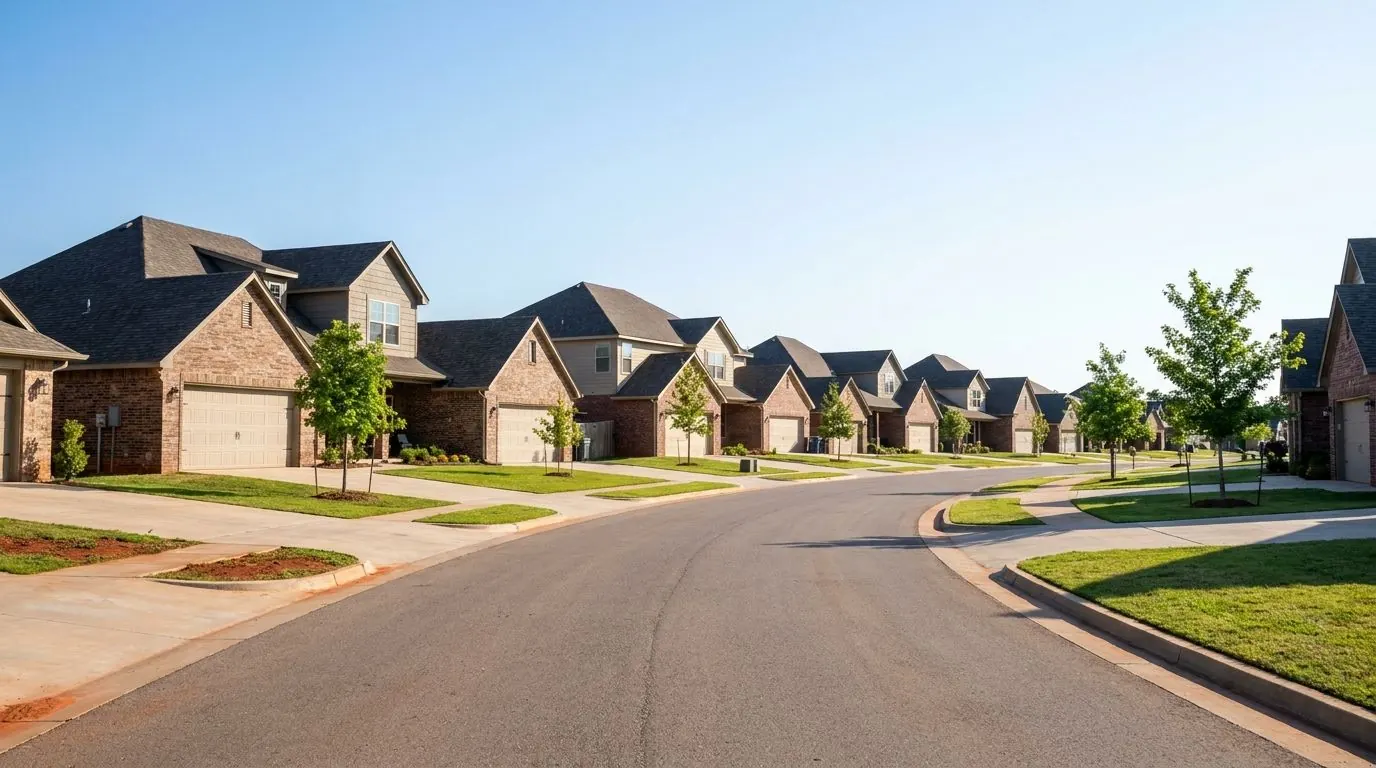
North and west of the older city, subdivisions such as Fairfax, Coffee Creek and Rose Creek were built largely from the 1990s into the 2010s. Two-story homes with a bonus room over an attached garage are typical, and that room is where comfort complaints in these houses usually start. The floor sits over a garage that can top 100°F in summer, knee walls back onto the hot attic, and the room is often the last stop on a long duct run. Some Edmond properties, mainly custom builds, have basements or walkouts, and storm cellars are common across the metro, which brings rim joist and below-grade work into the mix.
Neighborhood Notes
Downtown Edmond and the blocks near UCO
Mid-1900s homes, some converted to rentals. Attics are often thin and uneven, with fans venting into them. Air sealing, rerouting fan ducts outside and a cellulose top-up are the usual sequence, after a check for vermiculite.
Kickingbird
Established golf-course homes largely from the 1970s–90s. Settled, trampled attic fill and vaulted ceilings with thin pockets are common. We rebuild depth around the HVAC platform and add baffles where the soffits have been blocked.
Oak Tree
Larger homes of a similar era, many with complex rooflines and long attic duct runs. Duct sealing and wrap often matter as much as the attic layer, and thermal imaging helps sort out which one is driving the hot rooms.
Fairfax
Two-story homes built largely from the 1990s into the 2000s, where the garage-top bonus room is the usual trouble spot. The standard repair is closed-cell foam sprayed up into its subfloor, then a re-boarded Type X garage ceiling.
Coffee Creek and Rose Creek
Newer two-story subdivisions toward the north side, built largely through the 2000s and 2010s. Attics are closer to current levels, so the work is usually bonus-room floors, knee walls and the second-floor band joist.
East Edmond toward Arcadia Lake
Acreages with shops, barns and some custom homes with basements. Closed-cell foam on steel buildings, garage and shop insulation, and rim joist work in below-grade rooms are the common jobs.
Permits in Edmond
Authority having jurisdiction: City of Edmond
For addresses inside Edmond’s city limits, the City of Edmond runs its own building department, separate from Oklahoma City’s. A permitted finish-out, addition or new home includes its insulation in what gets reviewed. For a retrofit on its own, Edmond makes the determination, so we check rather than assume. Some properties with an Edmond mailing address, especially on the eastern acreages, lie beyond the city line in Oklahoma County’s unincorporated area; for those, ask the county what applies before work begins.
What Edmond Homes and Buildings Need Most
Bonus Rooms Over Garages
Fixes for a bonus room that won’t cool in summer or stay warm underfoot in winter.
Blown-In Cellulose Attic Top-Ups
Borate-treated cellulose blown over thin attic fill toward an R-49 benchmark.
Attic Air Sealing & Penetration Proofing
Hand-sealing attic penetrations, top plates, duct boots and the HVAC platform.
Cold Basement Walls & Rim Joists
Closed-cell foam on rim and band joists, basement walls and cellar concrete.
Pole Barns & Agricultural Shops
Spray foam that stops roof steel sweating in barns, shops and steel buildings.
Thermal Imaging & Draft Audits
Before-and-after infrared scans that show missing insulation and air leaks.
Insulation in Edmond: Questions
Our Fairfax bonus room is fine in winter but miserable every summer. Is that the same problem?
Our Edmond house has a basement. Should it be insulated like a basement up north?
Is spray foam in my east Edmond shop worth it if I only use it on weekends?
Insulation Work in Edmond?
Tell us the address and what is going on. Spray Tech Insulation works across Edmond and the surrounding area, and we will tell you what the job needs before we price it.