Thermal Imaging Insulation Inspections in Oklahoma City
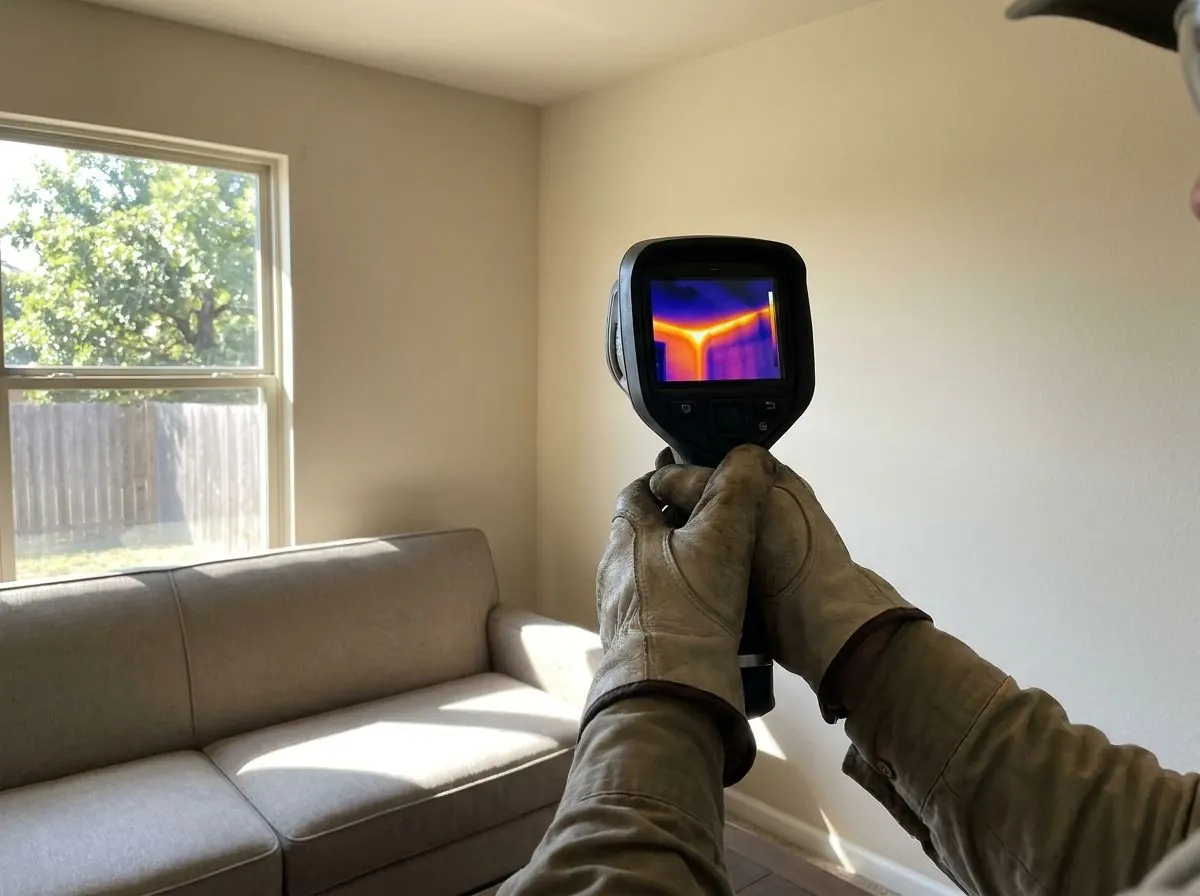
An infrared camera shows where your Oklahoma City home gains heat in July and loses it in January: missing insulation, air leaks, hot bonus-room walls and leaky attic ducts. We scan before insulation work to find the problem and after it to document the result.
The Problem It Solves
Most homeowners know a room is uncomfortable long before they know why. The upstairs bedroom that never cools in August, the bonus room over the garage that runs warmer than the rest of the house, the hallway ceiling that feels warm to the hand: each could be missing insulation, an air leak, a disconnected duct or something else entirely. Guessing is expensive. More insulation in the attic does nothing for a knee wall with nothing behind it, and new windows do nothing for a top plate leaking attic air into the wall.
Insulation defects are hidden by design. Once the drywall is up and the attic is full of loose-fill, nobody can see the batt that fell away from the subfloor, the cavity a framer left empty, or the gap between blown insulation and a knee wall. Even after new work, most people get only a receipt and a depth marker, which shows how deep the insulation is in one spot but not whether it covers the whole ceiling or touches the air barrier.
Oklahoma’s climate makes those defects cost the most in summer. With the attic running well above the outdoor temperature and the ducts usually up there with it, a small gap in coverage or a leaky duct connection becomes a hot spot the AC fights all afternoon. A camera turns hidden defects into pictures, which is the step that should come before anyone spends money on a fix, and the one that proves the fix afterward.
How It Works
An infrared camera reads the surface temperature of whatever it is pointed at and shows the differences as an image. It needs a real temperature difference between inside and outside, commonly at least about 18°F, so heat is moving through walls and ceilings. In Oklahoma a summer afternoon with the AC running and the attic baking provides that as reliably as a cold winter morning. Missing insulation shows as a warm patch on a cooled ceiling in July, or a cold one in January, and thermal bridges through framing show up as lines.
Air leaks come through more clearly when the house is depressurized. Exhaust fans, or a blower door fitted in an exterior doorway, pull air out so outside or attic air is drawn in through every gap, painting warm streaks across cool drywall at top plates, outlets, recessed lights and baseboards. The same pass shows attic duct leaks and hot bonus-room floors. What the camera cannot do matters as much: it does not measure R-value, and a scan with fans running is a diagnostic, not a formal air leakage test. We are not HERS raters or energy auditors, though we can work alongside one where a builder or program needs it.
How the Job Runs, Step by Step
Pick the day and the hour
We schedule for a strong temperature difference: a hot afternoon with the AC holding the house well below outdoor temperature, or a cold morning with the heat on. Mild spring and fall days often lack contrast, and if the forecast flattens out we reschedule rather than scan in conditions that hide defects.
Prepare the house
You keep the house at its normal setpoint with the windows closed beforehand. We note furniture against exterior walls, switch off lamps that create false hot spots, and walk the house with you first, so we know which rooms and complaints matter most.
Scan, depressurize, scan again
A first pass covers walls, ceilings, the attic access and any bonus room at normal pressure. Then fans or a blower door depressurize the house, and a second pass picks up leaks at top plates, outlets, fixtures, baseboards and registers. The attic and any reachable crawl or garage ceiling are scanned too.
Interpret and explain
Each finding is checked against the building: missing insulation, a duct behind the drywall, a joist, or sun on the outside wall? Suspect wet spots get a moisture meter. You get annotated images with a plain explanation of what each shows and what fix it points to, including fixes we do not sell.
Re-scan after the work
After insulation or air sealing, we scan the same surfaces under similar conditions, from the same positions where possible. Matching images document what changed and confirm whether a contractor’s work, ours included, covered what it was supposed to.
What Decides the Specification
Conditions drive scan quality more than the camera does. A small temperature difference produces flat images in which real defects disappear. Sun on a south or west wall heats the surface for hours, so exterior scans are best early or late. Wind changes leakage patterns, which matters in a state as windy as Oklahoma, and recent rain cools surfaces by evaporation. A cool patch can also be evaporation rather than water damage, so moisture findings are confirmed with a meter. We time the scan to suit the question being asked.
The house shapes the rest. Brick veneer, very common in the metro, hides most of the wall’s thermal pattern from outside, so the useful scanning is done from inside. Bonus rooms, knee walls and attics with ducts take extra time, as do homes where the question is one specific room. Exhaust fans are enough for most scans; a blower door gives more control and is worth the setup when air leakage is the main concern.
Oklahoma Code Notes
Thermal imaging is not a code requirement for an existing home, and a scan does not make work compliant. It does line up with how inspectors look at new work. Under the 2024 IRC as adopted in Oklahoma, with state amendments, Table N1102.5.1.1 is the air barrier and insulation checklist: sealed plates and penetrations, the attic access, recessed lights, and insulation in full contact with the air barrier. A camera is a good way to see whether those items were done. Where a city has adopted blower door testing, the climate zone 3 limit is 5.0 ACH50, and a qualified tester runs it. The city building department, such as the City of Norman or the City of Oklahoma City, decides what verification it accepts.
General guidance only. The city building department and the product’s own evaluation report decide what applies to your job.
Around Oklahoma City
In Norman, the older neighborhoods near the OU campus, such as Miller and Chautauqua, are full of early and mid-1900s houses, many of them rentals, with plaster walls, crawl spaces and additions from several different decades. A scan sorts out which walls were ever insulated, which additions were done well, and where an enclosed porch is pulling in attic air. In Oklahoma City, the 1920s to 1940s bungalows and Tudors of Edgemere Park raise the same questions, plus knob-and-tube risk that has to be settled before anyone dense-packs a wall. On newer two-story homes, the classic July finding is a bonus room with hot floors and knee walls.
Often Done Alongside
Attic Air Sealing & Penetration Proofing
Hand-sealing attic penetrations, top plates, duct boots and the HVAC platform.
Dense-Pack Cavity Injection
High-density cellulose injected into closed walls through small drilled holes.
Bonus Rooms Over Garages
Fixes for a bonus room that won’t cool in summer or stay warm underfoot in winter.
Where We Do This Work
Thermal Imaging: Questions We Get
Can a thermal scan be done in summer, or only in winter?
Will a thermal scan tell me the R-value of my attic?
Are you an energy auditor or a HERS rater?
What is the point of depressurizing the house during the scan?
How do you work out what my home actually needs?
Considering Thermal Imaging?
Tell Spray Tech Insulation about the job. We will look at it, tell you whether thermal imaging is the right fix, and price it in writing.