Spray Foam and Attic Insulation Across Choctaw’s Acreages
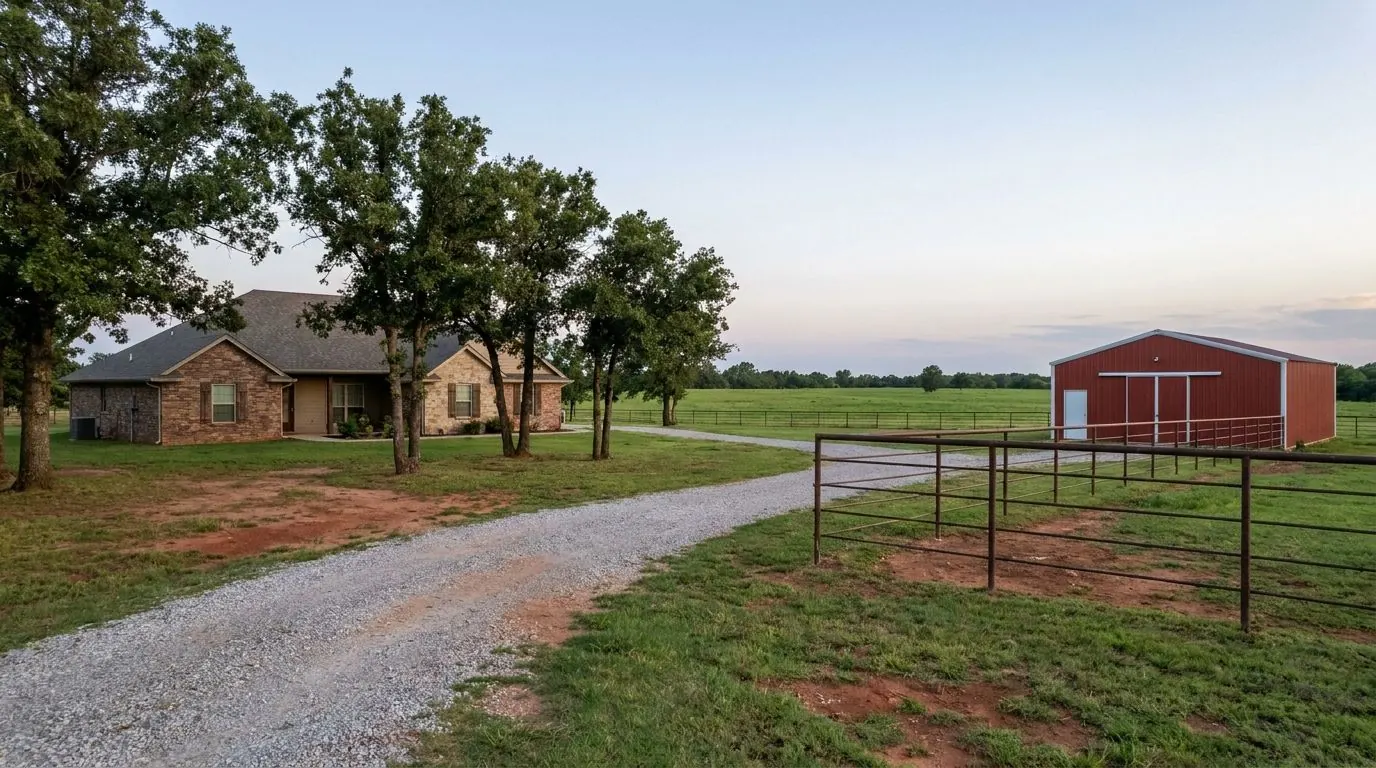
The city of Choctaw, in eastern Oklahoma County next to Nicoma Park and Harrah, feels more like the country than the suburbs. A typical property here might have a house, a metal shop, a barn and sometimes a manufactured home on the same few acres, and each building needs a different kind of insulation, or none at all.
At a Glance
- Permits issued by
- City of Choctaw
- From central OKC
- About 25-30 minutes east
- Main ZIP codes
- 73020
The Homes and Buildings in Choctaw
Large lots shape everything about insulation in Choctaw. Many properties have a site-built house plus one or more outbuildings: a steel-clad shop, a post-frame pole barn, a horse barn or a detached garage. Those buildings are where a lot of the work here happens. Bare roof steel takes the full Oklahoma sun all summer and then sweats on cool, humid nights, dripping on vehicles, tools, hay and tack and rusting fasteners from the inside. Closed-cell foam sprayed directly to the steel stops that condensation and slows the heat. Barns with livestock still need their ventilation, and exposed foam needs drywall or a coating accepted in the foam’s evaluation report wherever people work in the space.
Manufactured homes are a significant part of the housing here, from older single-wides to newer multi-section homes. Built under the federal HUD Code, they share a weak point: the underbelly. The bottom board under the floor gets torn by rodents, dogs or wind, the insulation behind it sags or falls out, and water lines are left exposed to arctic cold such as the February 2021 outbreak. Repairing the belly and re-insulating is a practical job. We keep access panels clear and never foam over heat-taped lines or shutoffs.
Choctaw also has a growing set of newer subdivisions, built mostly on slab with brick veneer and attic HVAC. Those houses behave much like suburban homes elsewhere in the metro, with reasonable attic levels and specific misses rather than wholesale problems. The older site-built farmhouses and ranch homes scattered across the acreages are the opposite: thin attics, crawl spaces under some of them, and decades of additions joined at awkward rooflines.
Neighborhood Notes
Shops and steel outbuildings
Metal shops used for vehicles, equipment and hobbies. Closed-cell foam direct to the steel stops dripping and heat, with a thermal barrier coating or drywall where the space is occupied. If you only park a tractor in it, foam may be more than you need.
Pole barns and horse properties
Post-frame barns that store hay or house animals. Foam controls roof condensation and resists the bird and rodent damage that wrecks exposed batts, but livestock buildings still need their ventilation left intact.
Manufactured homes
Single- and multi-section homes across the area. Belly repair and re-insulation, plus sealing the inside of the skirting where its design allows, are the common jobs. Skirting ventilation stays as designed, and the ground keeps a vapor retarder.
Older farmhouses and ranch homes
Site-built homes on acreage with thin attics and additions joined at odd angles. Air sealing, baffles and a blown-in top-up come first. Crawl spaces under some of these homes are worth checking for torn liners and loose insulation.
Newer subdivisions
Recent slab homes with attic HVAC. Attic levels are usually reasonable, so the work is targeted: a hot room, a garage being converted to a workshop or ducts that sweat in the attic.
Permits in Choctaw
Authority having jurisdiction: City of Choctaw
Choctaw’s own city government, the City of Choctaw, issues building permits within the city. A new shop, a home addition or a finished space is permitted work, and insulation within it is part of that permit. Whether an insulation-only retrofit calls for one is the City’s determination. Some acreage near Choctaw is unincorporated Oklahoma County land, and owners there should check with the county. Agricultural buildings are sometimes treated differently by permit offices, but that is never automatic; confirm with the city or county and with your insurer before assuming.
What Choctaw Homes and Buildings Need Most
Pole Barns & Agricultural Shops
Spray foam that stops roof steel sweating in barns, shops and steel buildings.
Mobile & Manufactured Homes
Bottom board repairs, belly insulation and skirting seals for manufactured homes.
2lb Closed-Cell Spray Foam
Dense 2 lb foam for crawl walls, rim joists, concrete and steel buildings.
Intumescent Thermal Barrier Coating
Listed intumescent coatings over exposed foam where drywall won't work.
Detached & Heated Garages
Full garage and shop envelopes for unit heaters, infrared tubes or mini-splits.
Blown-In Cellulose Attic Top-Ups
Borate-treated cellulose blown over thin attic fill toward an R-49 benchmark.
Insulation in Choctaw: Questions
Should I insulate my Choctaw horse barn or just ventilate it?
Can you fix the torn underbelly on my manufactured home?
My property has a Choctaw address but is outside the city limits. Who handles permits?
Insulation Work in Choctaw?
Tell us the address and what is going on. Spray Tech Insulation works across Choctaw and the surrounding area, and we will tell you what the job needs before we price it.