Dense-Pack Wall Insulation for Older Oklahoma City Homes
Dense-pack fills empty or slumped wall cavities through small holes, packing cellulose tight enough that it will not settle and slows air moving through the wall. In brick-veneer homes we usually work from inside, and before any wall is filled we check for blocking and rule out live knob-and-tube wiring.
The Problem It Solves
Many older Oklahoma City homes were built with nothing in the exterior walls at all. Before mid-century, a 2x4 wall was plaster or drywall, studs, sheathing and siding or brick, with an empty cavity in between. On a summer afternoon the sun bakes the south and west walls, the air in each bay heats up, and the plaster inside gives that heat back into the room long after sunset. In winter the same empty bays let cold air drift in at the baseboards and outlets, and the walls feel cold to the hand during an arctic outbreak.
Other walls were insulated once and have failed since. Loose fill poured into walls decades ago tends to settle into the bottom of each bay and leave the top empty, and old batts often slump or were never fit around wiring and blocking. A thermal scan on a hot afternoon shows the pattern plainly: warm bands at the top of each bay, stripes at the framing, and short bays above windows and below sills that were skipped entirely. The house runs its air conditioning hard while the walls quietly let the heat in.
The obvious fix, opening the walls, is the one most owners want to avoid. Original plaster in a 1920s home is part of its character, it is messy to demolish, and replacing it with drywall changes how the rooms look and sound. Brick veneer cannot simply be taken down and put back. Owners want the cavities filled without gutting the house, and without trapping water, burying live wiring or blocking the drainage space behind the brick.
How It Works
Dense-pack fills a closed cavity through a small hole. A flexible fill tube goes into each bay and reaches nearly to the far end, and the machine blows cellulose at high pressure as the tube is drawn back, packing the cavity to a density commonly about 3.5 lb/ft³. At that density the fiber locks itself into the bay and does not settle, and it is tight enough to slow air moving through the wall, which loose fill poured into a cavity cannot do. Every bay is filled until it will take no more, then the hole is plugged.
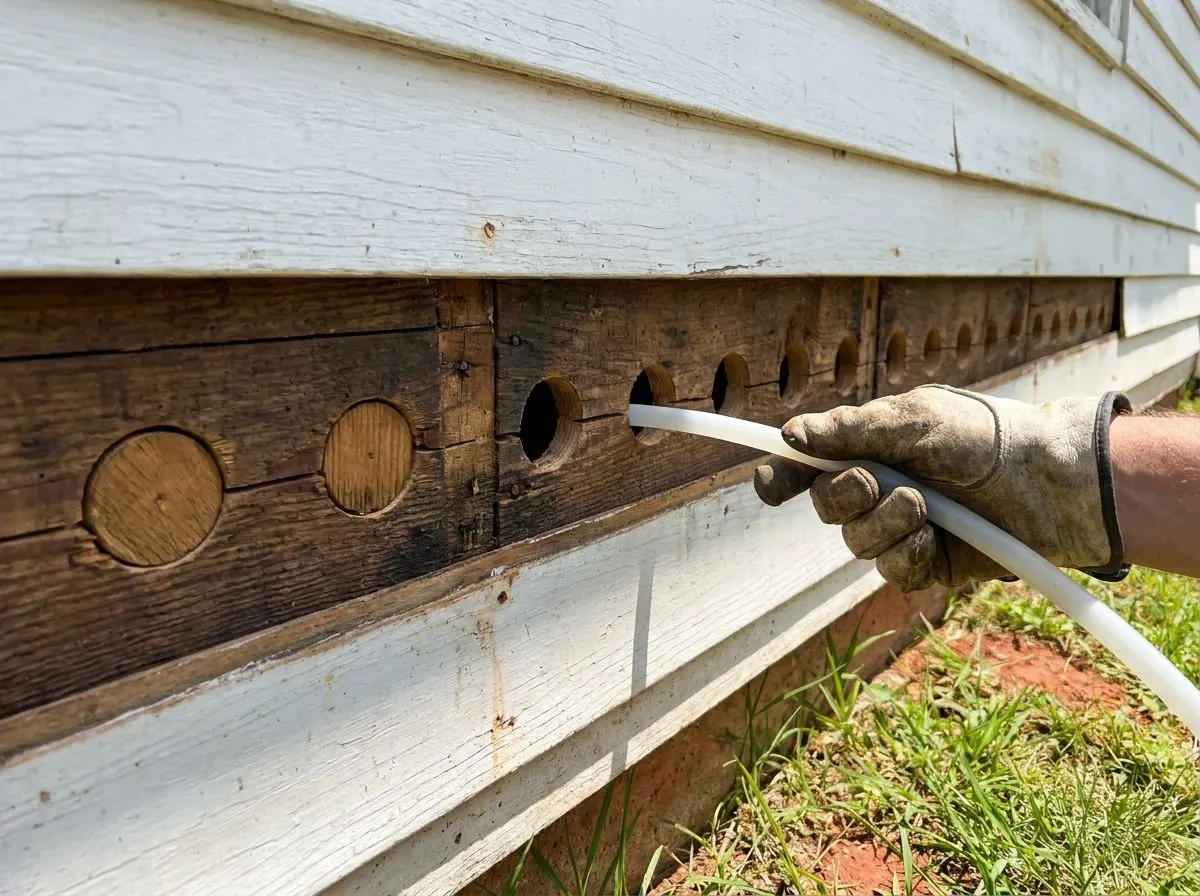
Access depends on the wall. Where a house has wood, vinyl or fiber-cement siding, we can remove a course, drill through the sheathing, fill, plug and seal the holes, and reinstall the siding, provided the water-resistive layer behind it is sound. Most metro homes are brick veneer over wood frame, and there we usually work from inside, drilling through drywall or plaster near the top and bottom of each bay. Mortar-joint access is possible only by agreement, and the air space behind the brick has to stay clear so the veneer can drain.
How the Job Runs, Step by Step
Wall survey and scan
We map which walls are empty, partly filled or full using a thermal camera on a hot afternoon or a cold morning, small probe holes and a look behind outlet covers. We note the wall construction, siding or veneer, headers over windows and doors, and any blocking or firestops at mid-height or floor lines.
Electrical and moisture checks
Before anything is filled, an electrician confirms there is no live knob-and-tube wiring in the walls we plan to fill, which matters in many pre-1940s homes. We also check the exterior for failed flashing, open joints and water-resistive layer damage, because a wet wall should never be packed full of fiber.
Drilling the pattern
We drill each bay above and below any blocking, from the side the access plan calls for: inside through drywall or plaster, or outside behind removed siding. Every section gets its own hole, including the short bays under windows and over doors that are easy to miss.
Dense-packing each bay
The fill tube goes in to the far end of the cavity and the machine packs it as the tube is withdrawn. The installer watches the pressure and the bag count per wall to confirm density, and rechecks any bay that took noticeably less material than its neighbors.
Plug, patch and record
Holes are plugged, then patched and primed inside, or sealed and covered by the reinstalled siding outside. We rescan where conditions allow and give you a record of the walls filled, the material, the coverage and the bag count.
What Decides the Specification
Density is the specification that matters. A cavity blown loose will settle and leave a void at the top; a cavity packed to roughly 3.5 lb/ft³ will not. Hitting that number takes a machine set up for dense-pack pressure, a fill tube rather than a nozzle at the hole, and an installer who counts bags against the wall area. Cellulose is the usual material. Some specialized fiberglass products are made for dense-packing and suit owners who prefer a glass fiber, with the target density set by that product’s data sheet.
The wall itself decides the access. Brick veneer, plaster, siding type and historic status all shape where we drill. Blocking, firestops at floor lines and diagonal bracing split cavities, and each section needs its own hole. Some older frame homes may have stud bays that run open from the crawl space to the attic, and those have to be closed off at the top and bottom first or the fiber will simply pour out. Walls with active leaks or rotten sheathing need repair before filling.
Oklahoma Code Notes
Under the 2024 IRC as adopted in Oklahoma, the state’s energy chapter amendments in OAC 748:20-6-16 set the wood-framed wall line for climate zone 3 at R-15. That governs new walls and permitted work. An existing wall being filled is not obliged to meet it, and a dense-packed 2x4 cavity is as full as that wall can get, so the honest goal is a completely filled cavity rather than a number on a label. Cellulose is manufactured to ASTM C739, and the dense-pack product’s data sheet sets its density.
Climate zone 3 does not require an interior vapor retarder on frame walls, so dense-pack in an old plaster wall works without adding one. Exterior changes in historic districts may go through historic preservation review, which is another reason interior access is common in the older neighborhoods. Whether the work needs a building permit is up to the City of Oklahoma City or whichever city the house sits in, so we confirm with them first.
General guidance only. The city building department and the product’s own evaluation report decide what applies to your job.
Around Oklahoma City
Heritage Hills and Mesta Park hold the metro’s densest concentration of early-1900s homes: many two-story, many with original plaster, and many with walls that were never insulated. These are the houses where dense-pack earns its place, because opening the walls would destroy finishes worth keeping, and where the knob-and-tube check is never optional. Crown Heights, just to the north, adds 1920s through 1940s bungalows and Tudors, some brick veneer and some frame, with the same empty or slumped cavities and the same reasons to fill from inside.
Often Done Alongside
Thermal Imaging & Draft Audits
Before-and-after infrared scans that show missing insulation and air leaks.
Blown-In Cellulose Attic Top-Ups
Borate-treated cellulose blown over thin attic fill toward an R-49 benchmark.
Attic Air Sealing & Penetration Proofing
Hand-sealing attic penetrations, top plates, duct boots and the HVAC platform.
Where We Do This Work
Dense-Pack Walls: Questions We Get
Can you dense-pack the walls of a brick house without touching the brick?
Will drilling holes damage my original plaster walls?
How do you know every wall cavity actually got filled?
Does a dense-packed wall need a vapor barrier in Oklahoma?
How do I know the work was done properly?
Considering Dense-Pack Walls?
Tell Spray Tech Insulation about the job. We will look at it, tell you whether dense-pack walls is the right fix, and price it in writing.