Blown Fiberglass Attic Insulation in Oklahoma City
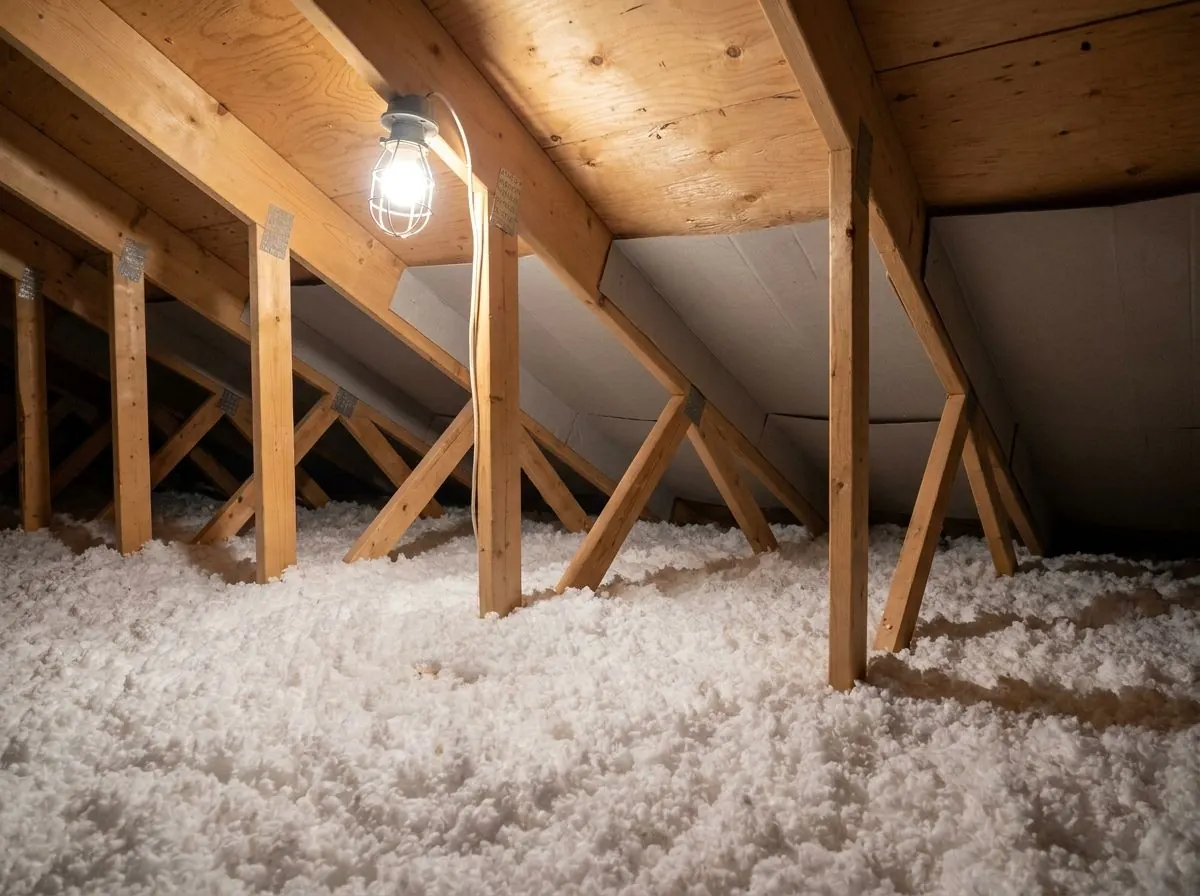
Loose-fill fiberglass is a light, non-settling attic top-up that stays at the depth it was blown to. It needs more inches than cellulose for the same R-value, and in a state this windy it needs wind dams at the eaves, so we check your attic’s height and soffits before recommending it.
The Problem It Solves
Oklahoma is one of the windiest states, with steady south winds through the summer and hard north winds behind winter fronts. That wind presses on the soffits and drives air into the attic at the eaves, right where the roof slope pinches the insulation down to its thinnest. In many metro attics the loose fill over the outside walls has been scoured back over the years, leaving the top plates and the first foot of ceiling nearly bare. That strip runs over the exterior walls and the corners of every room, which is why ceilings near the walls often feel warm in July and cold in January.
Some attics should not take a heavy new layer. Ceilings in older ranch homes are often thin drywall on wide framing, and some already show nail pops, sagging between joists or cracks along the taped seams. Piling a dense fiber on a ceiling like that asks it to carry more than it was hung for. Other attics carry a history instead: a roof leak that soaked the old fill, or a damp spell under the deck after a storm. Owners in those houses want a fill that does not hold water and will not pack down over the next decade.
Then there is the attic that simply needs more. Plenty of homes built from the 1970s through the 1990s have an even but modest layer, well short of R-49, that nobody has touched since the house was finished. Nothing is wrong with it except the depth. The owner wants a clean top-up that brings the ceiling to the benchmark without disturbing what is there, that adds little weight, and that will still read the same on the depth rulers years from now when the house is sold.
How It Works
Blown fiberglass is spun glass fiber, chopped into tufts and blown loose. It commonly runs about R-2.2 to R-2.9 per inch depending on the product, less per inch than cellulose, so the layer is deeper for the same R-value: often about 18 to 22 inches for R-49. In exchange it is light on the ceiling, settles minimally, does not absorb water and does not feed mold itself. Over an existing even layer it goes on clean, and the depth you see on the ruler the day we leave is close to what you will see years later.
The trade-off is air movement. Loose fiberglass is fluffier than cellulose and more prone to wind-washing, where air entering at the soffits drifts through the fill and strips its R-value at the eaves. So on every blown fiberglass job we treat the eaves as the critical zone: rafter vents in the soffit bays, a wind dam at the top plate so incoming air is steered over the fill instead of through it, and enough height over the plate to get real depth there. In a windy state, that edge detail decides whether the job performs.
How the Job Runs, Step by Step
Height and exposure check
We measure available height at the eaves and the center of the attic, because fiberglass needs more inches than cellulose. We note which sides face the prevailing south and north winds, check the soffit vents from outside, and look for vermiculite, rodents, roof-leak stains and bath fans venting into the attic.
Eaves first: baffles and wind dams
Rafter vents go in each soffit bay that needs one, and a wind dam goes at the top plate so air entering the soffit passes over the fill rather than through it. Hatch dams, flue clearances and covers on non-rated recessed lights go in at this stage too.
Markers and protection
Depth rulers go on trusses across the attic, with extras near the eaves on the windward sides. The machine stays outside, the hose runs to the hatch, and the route through the house gets drop sheets.
Blowing to chart density
Fiberglass blown too fluffy looks deep but misses its R-value. The installer keeps machine settings and hose technique consistent and counts bags as they go in, so both the thickness and the bag count match the coverage chart for R-49 over the attic area.
Eave inspection and receipt
We check depth at the eaves specifically, confirm the baffles still leave an open airway, weatherstrip and insulate the hatch, and hand you a receipt stating the installed R-value, thickness and coverage, as the FTC R-value Rule requires.
What Decides the Specification
Product choice drives the depth. Loose-fill fiberglass products vary in R per inch, so R-49 might need closer to 18 inches with one product and over 20 with another. The coverage chart decides, and both the minimum thickness and the minimum bag count on that chart have to be met, because thickness alone can be faked by blowing light. The existing layer counts too. Old batts or loose fill stay in place, and we credit them conservatively after measuring rather than taking the original label at face value.
The roof decides whether fiberglass fits. A steep roof over a large open attic has room for 20-plus inches, but a low-slope ranch roof can leave too little height at the eaves for a baffle plus a deep layer of fluffy fill. There, cellulose’s higher R per inch may get more insulation over the exterior walls. Ceiling condition pushes the other way: sagging or lightly framed ceilings favor fiberglass because it adds far less weight per square foot, and attics with a past moisture problem favor a fiber that will not hold water.
Oklahoma Code Notes
The 2024 IRC as adopted in Oklahoma, with state amendments under OAC 748:20-6, sets R-49 for new ceilings with an attic in climate zone 3. That covers the OKC metro and applies to new construction and permitted work; for an existing attic it is a benchmark rather than an obligation. Loose-fill mineral fiber, which includes blown fiberglass, is manufactured to ASTM C764, and the FTC R-value Rule requires us to state the installed R-value, thickness and coverage. Vented attics follow the IRC’s ventilation rule, and the insulation must not block soffit airflow. The city building department, Moore or Yukon for example, decides whether a top-up needs a permit.
General guidance only. The city building department and the product’s own evaluation report decide what applies to your job.
Around Oklahoma City
Moore has one of the metro’s largest stocks of ranch homes, much of it built from the 1960s through the 1980s, alongside the many homes rebuilt in the years after the 2013 tornado. The older ranches often have long, low attics with ducts across the joists and ceilings that have carried the same drywall for decades, which makes a light, non-settling fill a sensible choice. Out west, Yukon’s newer subdivisions toward Mustang Road and the Kilpatrick Turnpike sit open to prairie wind, and those attics show wind-washing at the eaves more than most, so the wind dam detail earns its keep there.
Often Done Alongside
Blown-In Cellulose Attic Top-Ups
Borate-treated cellulose blown over thin attic fill toward an R-49 benchmark.
Attic Air Sealing & Penetration Proofing
Hand-sealing attic penetrations, top plates, duct boots and the HVAC platform.
HEPA Vacuum Attic Insulation Removal
HEPA extraction of rodent-soiled, wet, moldy or smoke-damaged attic insulation.
Where We Do This Work
Blown-In Fiberglass: Questions We Get
Why does blown fiberglass need to be deeper than cellulose?
Does loose-fill fiberglass lose depth over the years?
Can blown fiberglass go over the old batts already in my attic?
How does wind get into attic insulation in the first place?
Do I need a permit for insulation work?
Considering Blown-In Fiberglass?
Tell Spray Tech Insulation about the job. We will look at it, tell you whether blown-in fiberglass is the right fix, and price it in writing.